

You've chosen the container and finished the artwork. Now you need to get that logo, product name and small text onto the packaging. Silk screen printing is one way to do it, and it's worth understanding how your design becomes a printed bottle or tube.
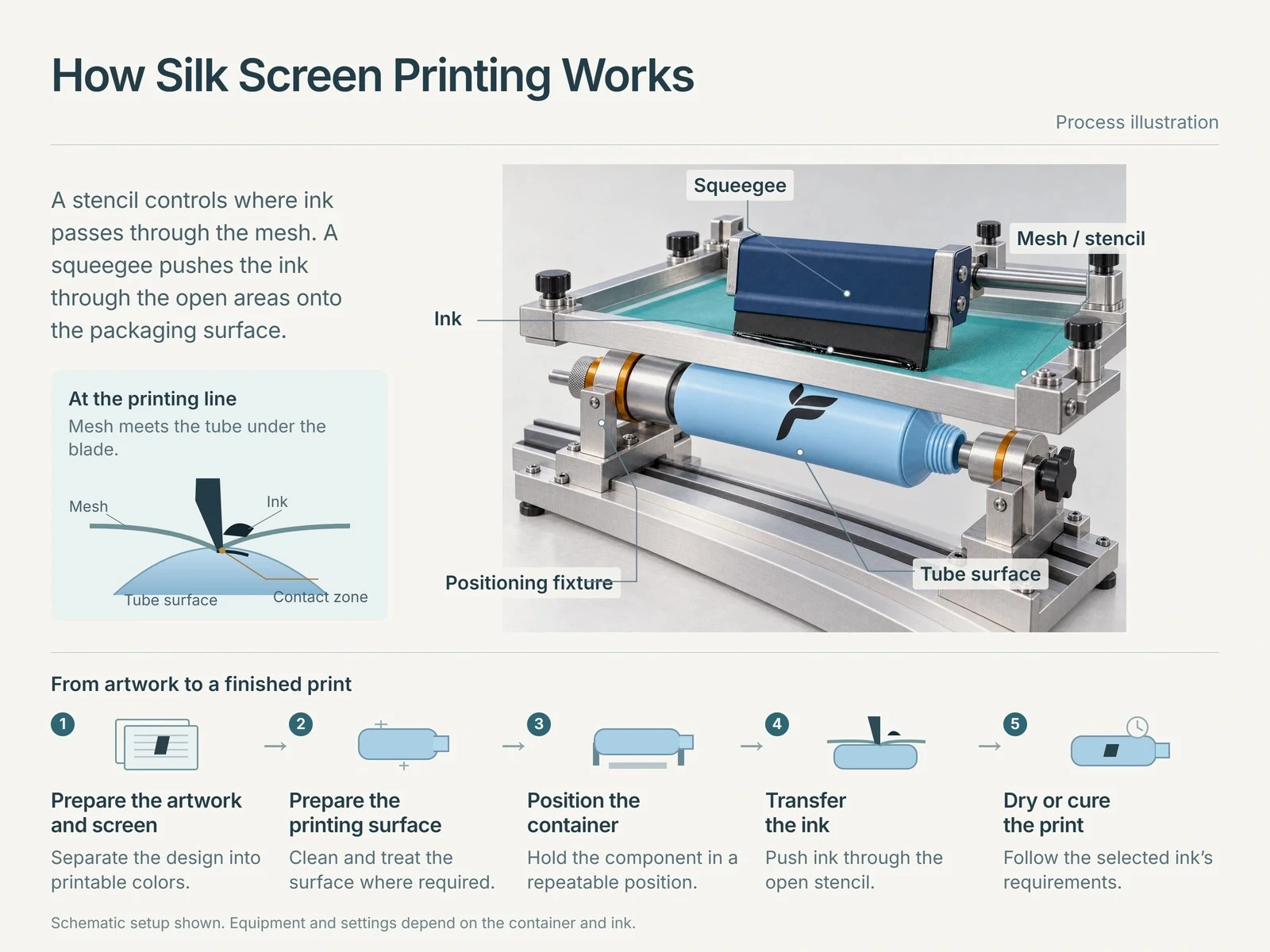
Also known as screen printing, the process uses a fine mesh screen carrying a stencil of your design. The stencil blocks ink outside the image area. A squeegee pushes ink through the open areas onto the packaging surface, leaving the printed design directly on the container.¹
The process sounds simple. In practice, the same artwork can need different printing setups on a rigid bottle and a squeezable tube. Before sending a design to print, it helps to know where silk screen printing works well and what to look for in a sample.
When Is Silk Screen Printing a Good Fit?
Silk screen printing works particularly well when the design relies on distinct colors and clear shapes. More complex artwork is possible, but the printing setup becomes more demanding.
|
Your design |
Fit for silk screen printing |
Main consideration |
|
A solid-color logo or product name |
Usually a good candidate |
Print area, edge definition and ink adhesion |
|
White graphics on a colored or transparent container |
A good candidate with suitable ink coverage |
Opacity and contrast on the finished package |
|
Several separate brand colors |
Feasible, with additional setup |
Color registration and separate printing passes |
|
Very small text or fine negative details |
Needs a sample at actual size |
Whether letters and gaps remain open and readable |
|
Photographs or continuous gradients |
Compare alternative processes first |
Required detail, halftone capability and production consistency |
Screen printing can reproduce halftones with a suitable setup. However, when photographic detail dominates the design, digital printing or a printed label may offer a more practical route. Frequent artwork changes are another reason to compare methods: new screens and setup work can affect the economics of multiple SKUs.
Our guide to cosmetic packaging printing and decoration methods can help you compare the options for your design.
How the Container Changes the Printing Decision
The ink touches a surface, not a material name on a specification sheet. A bare plastic bottle, a coated jar and a flexible tube can require different inks and preparation.
Low surface energy can prevent ink from wetting plastic properly. Surface treatment can improve its receptiveness to ink, but the appropriate method depends on the substrate and printing system. Enercon describes flame, corona and plasma treatment for three-dimensional parts; its guidance varies by material and ink combination.² A treatment requirement should therefore be established for the actual component.
Shape matters too. A straight cylindrical wall is generally easier to work with than a shoulder, taper or raised feature. The printable area depends on how the component is held and moved through the equipment. For cosmetic plastic bottles, choose the bottle shape and finish before locking the artwork.
A Real Example: FAMER's PCR Cosmetic Tubes
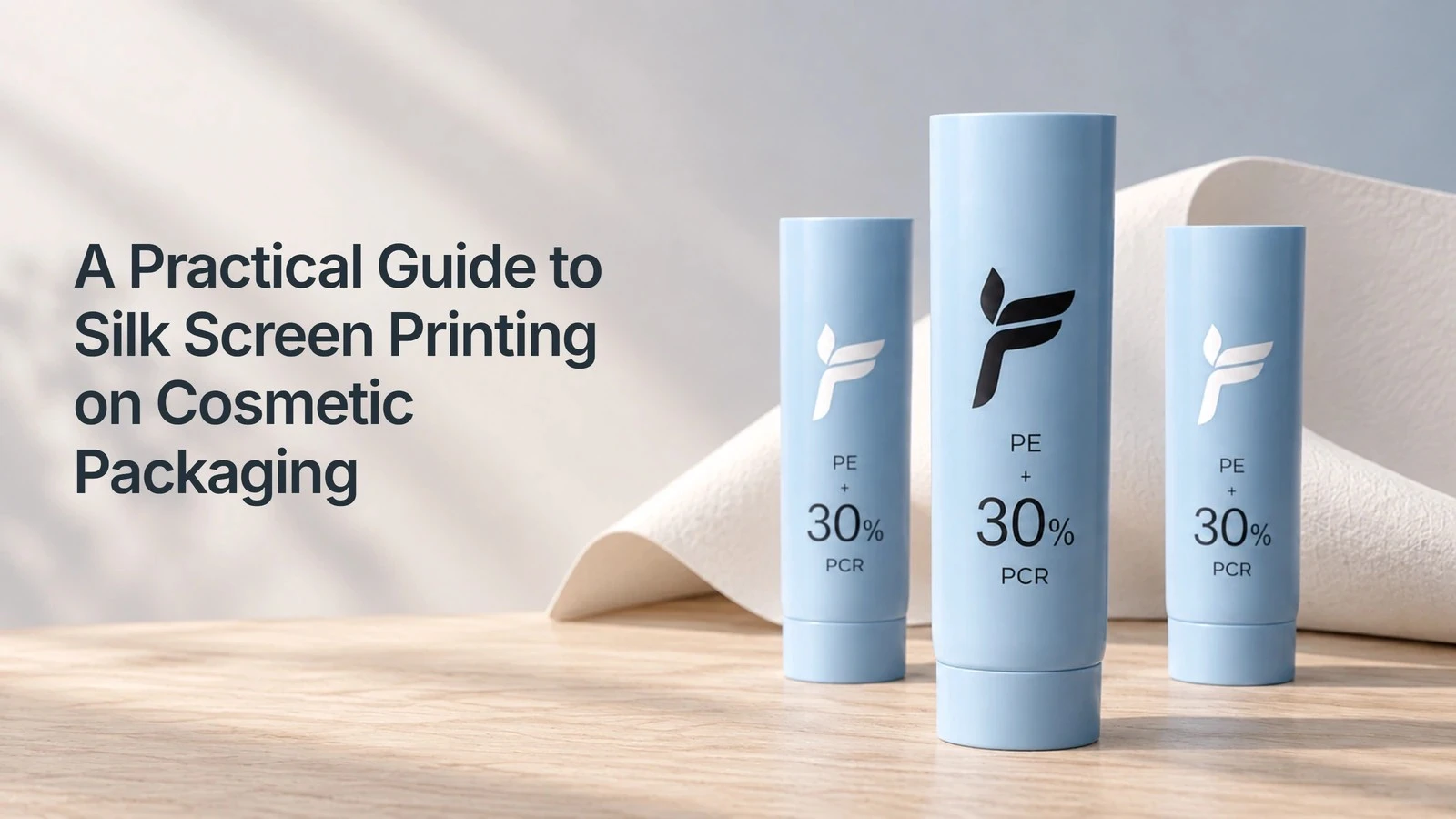
The blue tubes shown in FAMER's product image use PCR material and silk screen printing. The range includes black or white logos alongside black text: a practical example of solid-color decoration on cosmetic tubes.
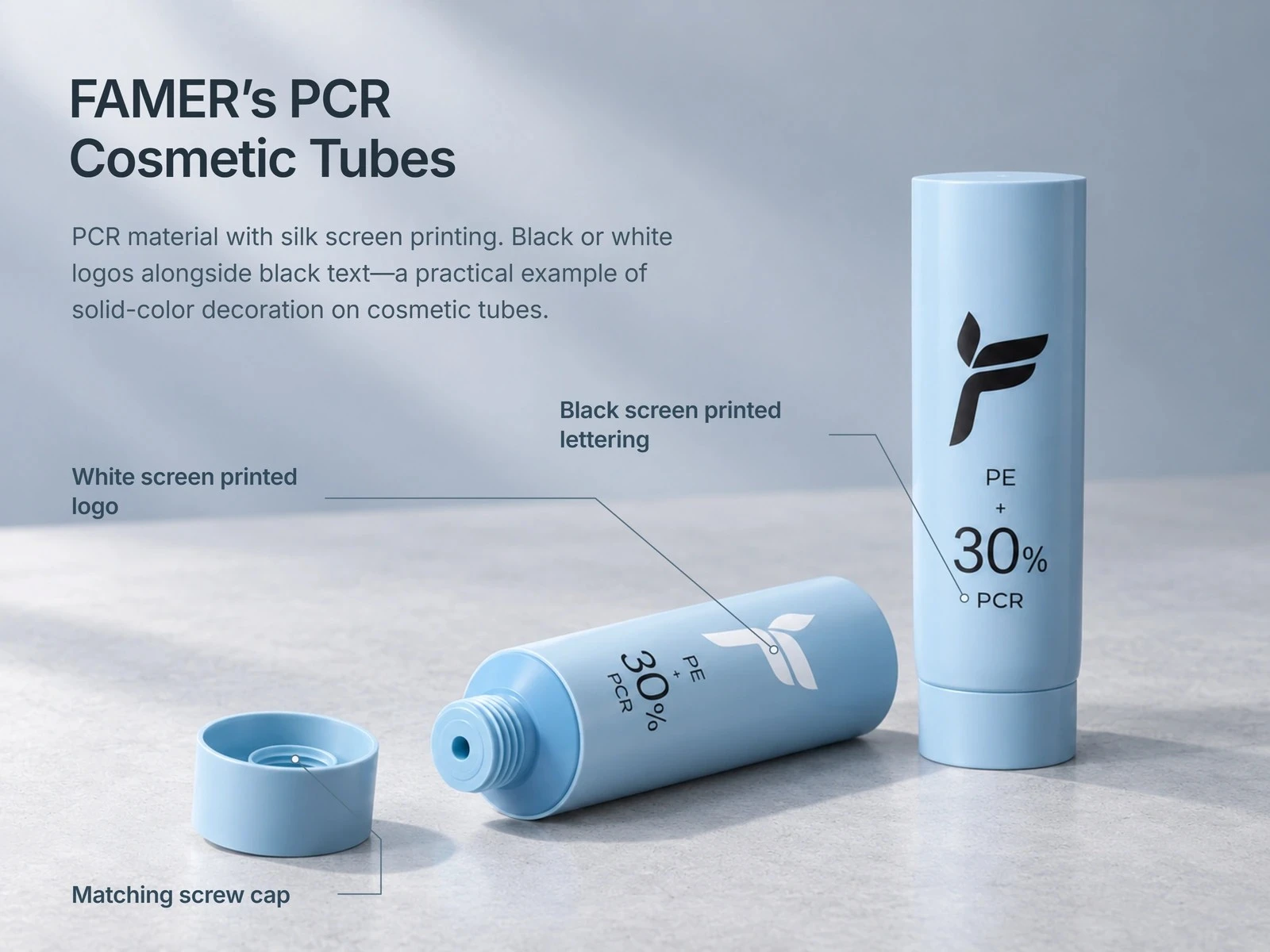
For this design, the main sample checks would be white-logo opacity, clean edges around the lettering and resistance to repeated squeezing. The dark and white logos should each be assessed against the actual blue surface rather than only on a white artwork background.
This product illustrates a feasible combination of PCR material and silk screen decoration. It does not establish the same ink or treatment requirements for every PCR package. The base resin, recycled-content specification and surface finish still belong in the individual product brief.
Explore our PCR cosmetic tubes to choose a component before developing the print layout.
How Silk Screen Printing Works on Cosmetic Packaging
The production sequence is straightforward, although the settings depend on the container and ink.
- Prepare the artwork and screen. The design is separated into printable colors. A stencil blocks the mesh outside the image, leaving openings where ink will pass. Each spot color typically needs its own screen.
- Prepare the printing surface. The component is cleaned and, where required, treated for the selected ink. If the package has a coating, that coating is part of the printing surface.
- Position the container. A fixture holds the part in a repeatable position. On a suitable cylindrical component, the container rotates in coordination with the screen movement to transfer the image around its wall.
- Transfer the ink. A squeegee pushes ink through the open areas of the stencil. Additional colors require controlled alignment so the separate images register correctly.
- Dry or cure the print. The ink follows its specified drying or curing process before inspection and handling.
FAMER's factory display includes equipment labeled for two-color and six-color silk screen printing. The appropriate machine and printing sequence still depend on the component and artwork.

Curing deserves attention because a surface that feels dry is not necessarily ready for final durability testing. For example, Nazdar's technical sheet for its 4300 Series UV Container Screen Ink requires pretesting the ink, substrate and production setup. It also explains that insufficient cure can affect adhesion and durability, while excessive cure can reduce flexibility and intercoat adhesion.³ These are requirements for that ink system, not universal settings for every screen ink.
UV screen printing and UV digital printing also use different image-transfer methods. "UV" identifies the curing approach; it does not make the two processes interchangeable.
Preparing Artwork and Color
A good artwork file reduces avoidable revisions, but it needs to match the actual package.
Give the printer:
- The component's print template, with the design placed at its intended size.
- Editable vector artwork where available, with fonts outlined or supplied as requested.
- Separate color specifications, including white ink or an underbase where needed.
- A clear orientation reference, such as the position relative to the cap, seam or front panel.
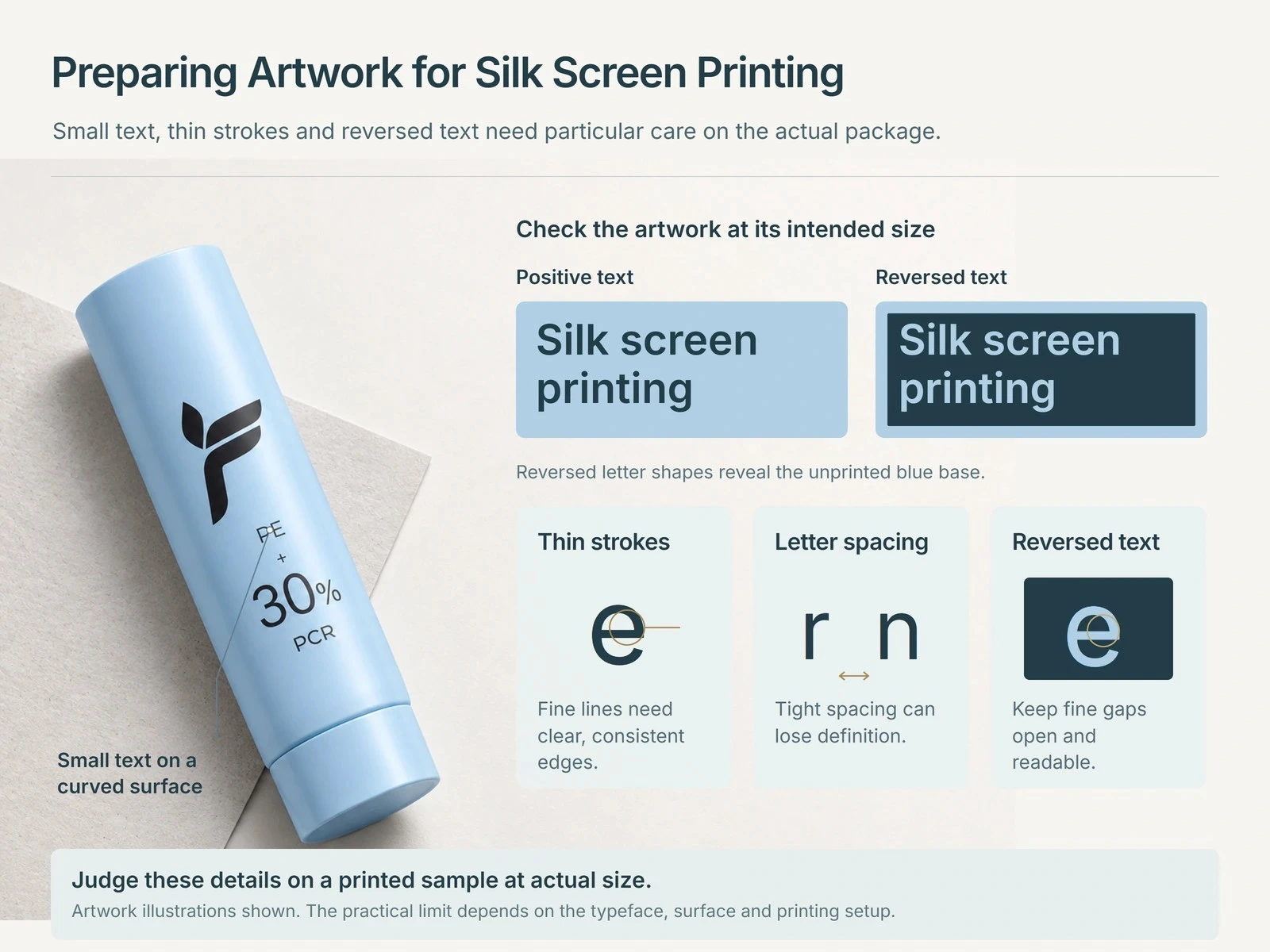
Small text needs particular care. There is no reliable minimum font size that applies to every container, ink and machine. Thin strokes, tight letter spacing and reversed text can lose definition even when the file looks clear on screen. Judge these details on a printed sample at actual size.
For color, use a physical reference alongside the color code. Pantone recommends a current, unfaded physical sample for real-world color communication because a digital display does not reproduce physical color in the same way.⁴
The final approval should happen on the selected container. Its base color and finish affect the appearance of the print; on transparent packaging, the visible contents may affect contrast too. For FAMER's blue PCR tubes, the white logo needs enough opacity to remain distinct, while the black text needs sharp edges and consistent coverage.
What to Check on a Printed Sample
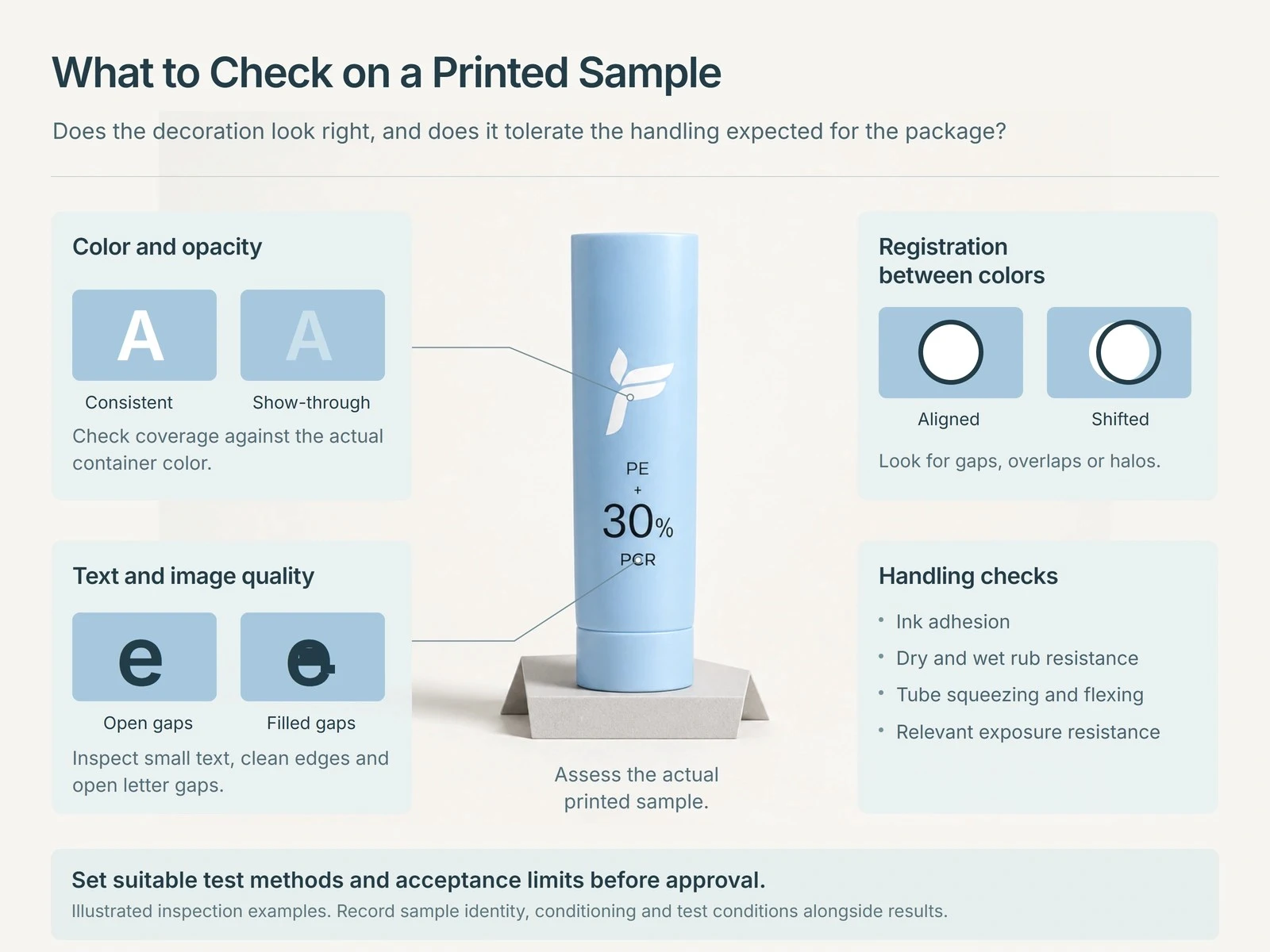
A sample should answer two questions: does the decoration look right, and does it tolerate the handling expected for that package?
Use the following checklist to plan sample approval. Select the test methods and acceptance limits for the component and its intended use.
|
Check |
What to look for |
|
Color and opacity |
Match to the approved physical reference; consistent coverage; no unintended show-through |
|
Position and orientation |
Correct distance from the cap, seam and other reference points; consistent placement around the component |
|
Text and image quality |
Readable small text, clean edges, open letter gaps, and no missing areas, smears or pinholes |
|
Registration between colors |
Correct alignment without unintended gaps, overlaps or halos |
|
Ink adhesion |
Lifting or detachment under a suitable adhesion assessment after the specified conditioning period |
|
Dry and wet rub resistance |
Color transfer, smearing or visible wear under defined rubbing conditions |
|
Scratch and handling resistance |
Damage under a repeatable method representative of handling and transport |
|
Tube squeezing and flexing |
Cracking, flaking or loss of adhesion as the tube deforms |
|
Relevant exposure resistance |
Changes after exposure to moisture or substances likely to contact the exterior during use, such as the dispensed formula or a relevant cleaning agent |
Alcohol resistance is worth checking when alcohol contact is part of the intended use. It should not be presented as a universal requirement or guaranteed property of silk screen printing.
A tape or cross-cut test also needs an appropriate method. ASTM D3359 was developed for coatings on metallic substrates; its scope discusses limitations when applying it to nonmetallic substrates.⁵ For a plastic cosmetic component, the chosen method needs to suit the substrate, coating and geometry rather than borrowing a pass grade without context.
Keep the conditions alongside the result: sample identification, time after curing, test medium, rubbing or squeezing procedure, and acceptance criteria. Photos of a failure can help the printer investigate it, but the symptom alone does not prove the cause. Peeling, for example, can involve surface preparation, contamination, ink selection or curing.
These decoration checks assess the exterior print. Formula compatibility with the complete packaging system requires its own evaluation.
Planning Your Silk Screen Printing Project
Cost depends on more than the number of containers. Color count, screens, printing positions, fixtures, artwork versions and order quantity all affect setup and production work. A two-color design on one print area is a different quotation from several colors across multiple areas and SKUs.
A useful quotation brief includes the component, material specification, surface finish, artwork, color requirements, quantity by SKU and intended use. If PCR material is specified, identify the relevant component and recycled-content requirement rather than treating "PCR" as a complete resin specification.
Before bulk production, keep an approved printed sample and the matching artwork version as the reference. This gives both sides a concrete basis for evaluating color, placement and appearance.
Planning a printed bottle, jar or tube? Send FAMER your selected component, artwork and order requirements for a decoration review and quotation. If you are still choosing the container, start there so the print layout can be developed around its actual surface and dimensions.
Frequently Asked Questions
Can PCR cosmetic packaging be silk screen printed?
Yes. FAMER's blue PCR cosmetic tubes are one confirmed example. Feasibility for another component depends on its base resin, surface condition, ink and production setup, so the print should be assessed on that component.
How small can silk screen printed text be?
The limit depends on the typeface, stroke width, spacing, substrate and printing setup. Supply artwork at its intended size and inspect the printed sample, including reversed text and fine gaps.
How many colors can be printed?
The available equipment, container and artwork determine the practical color count. Separate spot colors typically require separate screens and controlled registration. More colors can add setup work and printing passes.
Is silk screen printing better than labels?
It depends on the design and purchasing requirements. Direct screen printing is a useful option for solid-color graphics on the container. Labels may be more convenient for detailed images, extensive text or frequently changing artwork. Compare both on the actual package and order quantity.
Why does screen printed ink peel off a plastic container?
Possible causes include unsuitable surface preparation, contamination, an incompatible ink or inadequate curing. A useful investigation starts with the actual material, ink system and production conditions rather than assuming all peeling has the same cause.
What is the minimum order quantity for silk screen printing?
There is no universal MOQ. It depends on the supplier's setup, container, color count and quantity per artwork version. Request a quotation for the exact component and design.
References
- PRINTING United Alliance, Glossary of Printing Terms. Used for the definition of screen printing.
- Enercon, An Overview of Surface Treatment for Three-Dimensional Parts. Used for surface-energy principles and material-dependent treatment selection.
- Nazdar, 4300 Series UV Container Screen Ink Technical Data Sheet. Used for this ink system's pretesting and curing considerations.
- Pantone, Physical Color Samples. Used for the recommendation to communicate color with a current physical reference.
- ASTM International, ASTM D3359. Used for the stated scope and limitations of the tape adhesion test standard.