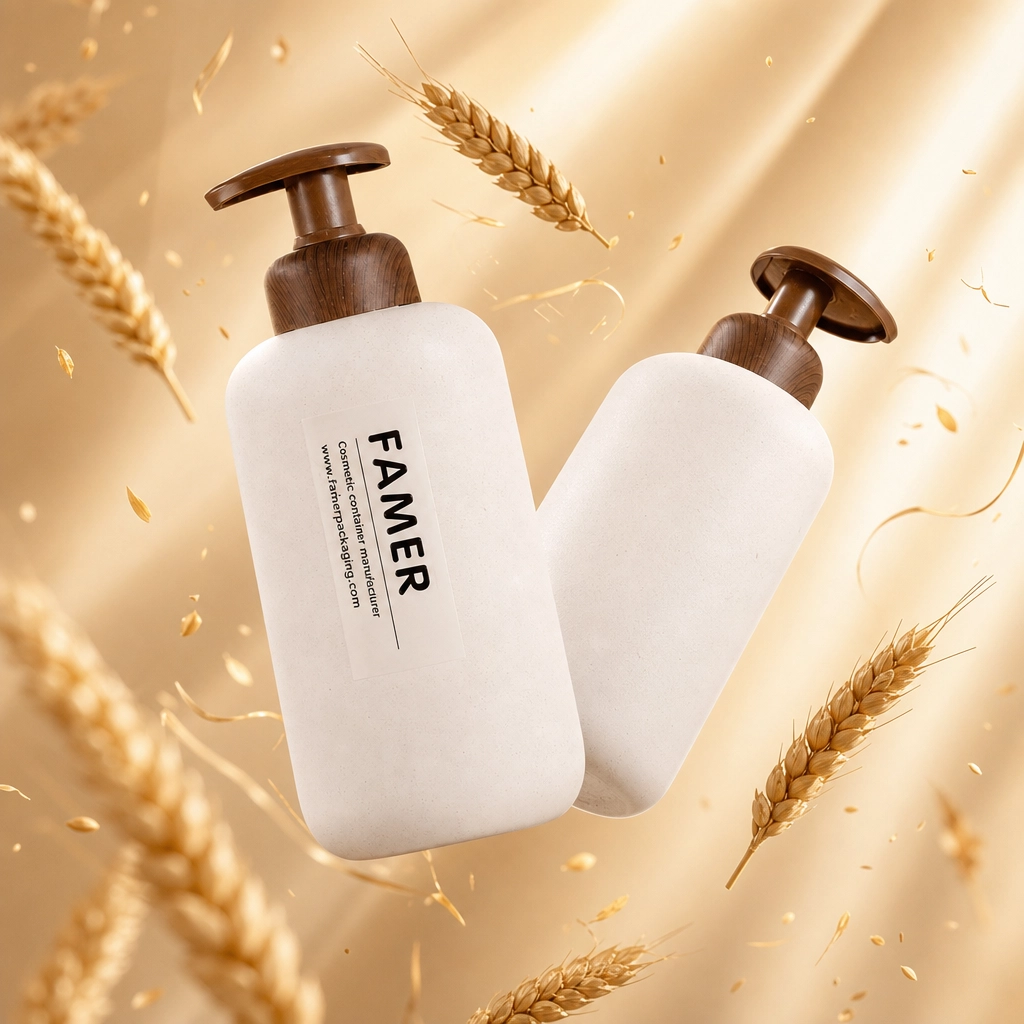


Choosing a sustainable cosmetic packaging material is not a question of which one is greenest. It is a question of which one your line can run, your formula can tolerate, and your market will let you describe accurately.
PCR, PLA, sugarcane-based PE and wheat straw are usually listed side by side as if they were four versions of the same decision. They are not. PCR changes the feedstock. Sugarcane-based PE changes the feedstock while keeping PE chemistry. PLA changes the polymer itself. Wheat straw composite adds a physical filler to a polymer that otherwise stays as it is.
Sort them that way and most of the confusion disappears - including the claim questions that cause the most trouble in this category.
For the wider range of formats we manufacture beyond the four materials below, see our eco-friendly packaging overview.
Four terms that are not interchangeable
Nearly every misleading packaging claim traces back to one of four words being used in place of another. They describe different properties, and they are regulated differently.
- Bio-based describes where the carbon came from. It says nothing about what happens to the material after use. Bio-based PE is chemically identical to fossil PE.
- Biodegradable describes what a material does under specific conditions over a specific period. Without a named standard, a timeframe and a defined environment, the word has no testable meaning.
- Compostable is the stricter, certifiable version: the finished item meets a defined standard - EN 13432 in Europe, ASTM D6400 in the United States[8] - and breaks down within a set time in a defined composting environment.
- Recycled content describes the origin of the material, not its destination. A package made from 100% recycled resin is not automatically recyclable[2], and a package made from virgin resin is not automatically unrecyclable.
Bio-based and biodegradable sit on separate axes. A material can be bio-based and non-biodegradable, which is exactly the case for bio-based PE, or fossil-based and biodegradable. Keeping the two axes apart removes most of the ambiguity in this field[1].
|
Material route |
What changes |
What you can specify |
End-of-life consideration |
Check before choosing |
|
PCR plastic |
Feedstock source |
% post-consumer recycled content |
Follows the base polymer and the complete package design |
PCR percentage, component scope, appearance and compatibility |
|
PLA |
Polymer |
Grade and material specification |
Industrial composting only where the finished item qualifies and suitable infrastructure exists |
Heat, moisture, formula and finished-part performance |
|
Sugarcane-based PE |
Feedstock source |
Bio-based content when supported by documentation |
PE route where the complete package is accepted |
Material documentation and complete-package design |
|
Wheat straw composite |
Filler content |
Agricultural straw percentage |
Largely determined by the polymer matrix |
Polymer base, filler percentage and appearance tolerance |
|
Conventional PET / HDPE / PP |
Baseline |
Resin specification |
Resin-specific collection and recycling route |
Formula, closure, decoration and local collection system |

PCR: the same polymer, a different feedstock
PCR - post-consumer recycled plastic - is the least disruptive of the four routes. A PCR HDPE bottle is still HDPE. It behaves like HDPE on the filling line, in the warehouse and in the waste stream. Only the origin of the resin changes.
That makes it the safest starting point for a brand that wants a measurable environmental specification without changing the package.
Two variables do move in practice, and both are better settled before tooling than after.
- Batch-to-batch variation. Recycled resin arrives from many sources, so colour and surface appearance drift more than with virgin material. For clear or precisely colour-matched parts, expect to blend PCR with virgin resin to hold a stable appearance, and set the acceptable range from approved samples.
- Component scope. PCR content is normally quoted for the main body. Pumps, droppers, caps and multi-layer tubes are harder to source in recycled grades, so a claim that covers the whole pack has to be verified component by component.
Neither point makes PCR a compromise. It makes the specification worth writing down before the mould is cut.
If you need the detail behind recycled-content specification and traceability, we set it out in what PCR plastic means for cosmetic packaging.
For the formats we mould in recycled grades, see our PCR cosmetic packaging range.
Famer specification: 10% to 100% PCR content, confirmed per component and configuration
Standard MOQ: 5,000 pcs
PLA: a different polymer, with its own limits
PLA is the only route here that replaces the polymer itself, which makes it the most consequential option environmentally and the most demanding one in production. It is not a drop-in replacement for PP or PE.
- It has to be dried. PLA is a polyester and hydrolyses in the presence of moisture, so the resin must be dried before processing - a step that PP and PE do not need at all. Run it wet and parts come off the machine with silver streaks and weak weld lines.
- The processing window is narrow. Melt and mould temperatures sit in a tighter band than for polyolefins. A line that runs PP well will not simply run PLA well, so a switch should be treated as a full re-qualification rather than a parameter adjustment.
- It is notch-sensitive. Threads, snap fits and thin walls are where failures appear first. Part design and wall thickness normally need review before tooling.
- Heat is often the limiting factor. NatureWorks publishes a heat distortion temperature of 55°C for its Ingeo 3052D injection-moulding grade and positions that grade for use below 49°C[3]. Those figures belong to one grade, not to PLA as a family - but they show why heat exposure has to be tested on the finished part rather than assumed from the material name.
The same caution applies to compostability. EN 13432 and ASTM D6400 apply to finished items under defined conditions[4], so a PLA resin does not make a cosmetic package automatically compostable. The complete item has to qualify.
We went through the performance limits and the end-of-life picture in more detail in where PLA works in cosmetic packaging and where it does not.
Our PLA cosmetic packaging range covers the formats we currently mould in this material.
Sugarcane-based PE: bio-based, chemically the same
This is the route buyers most often misread. Sugarcane-based PE is not a new plastic. It is ordinary polyethylene whose carbon came from sugarcane instead of petroleum - same processing, same performance, same waste stream.
From a production standpoint, that is its strongest argument. No drying step, no new temperature window to learn, no change to tooling assumptions. Moving from fossil PE to bio-based PE is largely a sourcing and documentation exercise.
From a claims standpoint, it is also the most easily overstated. The safety data sheet for the Braskem LDPE grade we can supply describes the material as having high persistence and slow degradability[5]. That is standard language for polyethylene, and it is accurate: changing the carbon source does not make PE biodegradable.
On a life-cycle basis there is a genuine difference, because the feedstock pulls atmospheric carbon into the material. That is a feedstock claim, and it needs feedstock documentation to support it[9].
We compared the two PE routes and what the feedstock change does and does not deliver in sugarcane-based PE versus conventional PE.
The bio-based sugarcane packaging range we offer starts from the same PE grade as its fossil equivalent.
Wheat straw composite: a filler, not a polymer
Wheat straw composite is a different kind of change again. The polymer stays as it is and agricultural fibre is added to it. Our material contains 30% straw.
Two consequences follow, and both matter commercially.
- It does not make the package biodegradable, and it does not move the pack into a different recycling stream - though filler content can still affect how near-infrared sorters read it.
- It changes the appearance, permanently. Natural fibre produces specks, texture and colour variation in the moulded part. For some skincare brands that is the point of the material; for others it is a defect. Either way it has to be written into the appearance standard before tooling, because it cannot be tuned out afterwards.
Filler loading is the other trade-off. Impact strength falls as straw content rises, so the practical percentage depends on wall thickness and the duty of the part rather than on what looks best in a specification.
We examined the sustainability question and the claim limits in whether wheat straw cosmetic packaging is really sustainable.
Keep PET, HDPE and PP in the comparison
A conventional resin is not automatically the wrong answer, and treating it as a fallback does buyers a disservice. PET, HDPE and PP are what most cosmetic packages already use, and they carry the most developed collection and recycling infrastructure in most markets.
They also supply the baselines that environmental claims depend on. "Reduces virgin plastic" is measurable only against a defined reference package. "Recyclable" depends on the resin and the pack design in front of you, not on a material family.
For formulas with demanding compatibility, transparency or barrier requirements, a conventional resin is often the right starting point - with a recycled or bio-based route evaluated on top of it rather than instead of it.
If the base resin is the first decision, our comparison of PET, HDPE and PP bottles covers where each one fits.
What usually goes wrong in production
Most material comparisons stop at the resin data sheet. The problems that cost money appear on the line, and they differ by route. These are the failure modes we see most often across these four materials.
|
Material |
What commonly goes wrong |
What prevents it |
|
PCR |
Colour and speck level drift between batches |
Write an appearance standard and allow blending with virgin resin |
|
PCR |
Claim covers the whole pack but only the body contains recycled material |
Define the scope component by component |
|
PLA |
Silver streaks, weak welds and short shots |
Dry the resin and re-qualify the temperature window before production |
|
PLA |
Cracks appearing at threads and snap fits |
Review wall thickness and part design before tooling |
|
Sugarcane-based PE |
Material documentation does not cover the percentage being claimed |
Confirm the feedstock certification scope before artwork |
|
Wheat straw composite |
Natural specks and colour variation read as defects on arrival |
Agree the appearance standard on samples, before moulds are cut |
|
Wheat straw composite |
Impact failures as filler loading rises |
Match the straw percentage to wall thickness and part duty |

One principle covers all of it. Moving between these routes is a change of material in a qualified process, not a substitution of one resin for another. A sampling round and a short trial run cost a fraction of discovering the problem inside a full production order.
Where each material actually goes after use
A material's recycling story has two parts: what the resin is accepted as, and what the finished pack is accepted as. They are not the same, and the second is where most projects lose the benefit they were counting on.
|
Material |
Nominal stream |
In practice |
|
PCR (PET) |
#1 PET |
Accepted wherever PET bottles are collected. Recycled content does not change the stream. |
|
PCR (HDPE) |
#2 HDPE |
Treated exactly as conventional HDPE. |
|
PLA |
Industrial composting only |
Not accepted in PET or PE mechanical recycling. Needs separate collection and an industrial composting facility. |
|
Sugarcane-based PE |
#2 HDPE / #4 LDPE |
Identical to fossil PE. Sorting equipment cannot see the difference, and does not need to. |
|
Wheat straw composite |
Nominally #5 PP |
Filler content can affect near-infrared sorting and often routes the pack to #7 Other. |
|
Conventional PET / HDPE / PP |
Resin-specific |
Depends on the resin and the local collection system. |

The component, not the bottle, is usually the obstacle. A pump, a dropper, a multi-layer tube wall or a metallised cap will not be separated by the consumer or by most material recovery facilities. A body moulded in a perfectly recyclable resin, fitted with three components, ends up in residual waste. This is true of every material covered here, and it is the single most common reason an environmentally framed package does not deliver what the artwork implies.
It is also why we keep the wording specific. Recyclability describes a package design against a collection system that actually exists in the destination market, not a property of the resin.
Choosing by package format
The same material route does not suit every cosmetic format equally well. Screening gets faster when the package and the formula come first.
Shampoo, body wash and larger bottles
HDPE and PP formats are the established choice here, and PCR can substitute for part of the virgin resin without changing the polymer family. Wheat straw composite is a realistic option where a matte surface and visible natural texture suit the brand - with the appearance standard agreed on samples first.
Cream jars
PP is the usual starting point for evaluating PCR content or straw filler in a jar. A material that looks suitable on a data sheet still has to work as a thick-walled, multi-component pack, so the closure, decoration and wall construction belong in the same evaluation.
Cosmetic tubes
For PE tubes, PCR is the most straightforward recycled-content route. The specification that matters is not "PCR tube" but which layer or component contains the recycled material and at what percentage. Sugarcane-based PE is the alternative where the objective is to change feedstock without leaving the PE family.
Serums, fragrances and demanding formulas
Packages for serums, fragrances and formulas with high alcohol or essential-oil content should be selected around compatibility and barrier performance first. Transparency adds a further constraint. In these projects a recycled or bio-based route is an addition to the requirement, not a substitute for meeting it.

Choosing by target market
The same material is not equally defensible everywhere, because collection infrastructure and claim rules differ by market.
European Union. Packaging design and labelling rules are legal obligations rather than voluntary targets. Recycled-content minimums under Regulation (EU) 2025/40 start applying from 2030 for plastic packaging[7], and generic environmental claims fall under restriction by Directive (EU) 2024/825[6]. Compostable plastic packaging is currently exempt from the recycled-content obligation, which is the one structural advantage the PLA route holds here - and it comes with the requirement that the pack actually reaches an industrial composting facility.
North America. The FTC Green Guides govern how claims may be made, and they require recyclability and recycled-content claims to be qualified where access to recycling is limited. Collection is fragmented at state and municipal level, so that qualifier is doing real work rather than being decorative.
Asia-Pacific. Collection and processing infrastructure varies more widely here than in either of the other two markets, and it varies within countries as much as between them. The practical step is to check the material against the specific destination market rather than against a regional average.
What you can claim, and what you cannot
Claim review is where material choice meets marketing language, and it is where most of the risk sits. The test is simple: can you document the specific attribute, for the specific component, in the market where the product will be sold?
|
What you want to say |
Can you say it? |
What has to support it |
|
Made with 30% post-consumer recycled plastic |
Yes |
Measured recycled content for the stated component |
|
Made with 30% agricultural straw |
Yes |
The material specification for that component |
|
Made with bio-based PE |
Qualified |
Certification or documentation of the feedstock share, such as ISCC PLUS |
|
Made from renewable feedstock |
Qualified |
Documentation covering the stated scope of the claim |
|
Recyclable |
Qualified |
Pack design plus a collection system that accepts it |
|
Industrially compostable |
Qualified |
Certification of the finished item to EN 13432 or ASTM D6400 |
|
Biodegradable |
No, unless qualified |
A named standard, a timeframe and defined conditions |
|
Eco-friendly, green, sustainable |
No |
Not a specific attribute; not substantiable as a stand-alone claim |

Those last two rows are not a matter of caution. They are current law. Under Directive (EU) 2024/825, member states must apply their implementing measures from 27 September 2026[6], and the Directive targets generic environmental claims such as "eco-friendly", "green", "biodegradable" and "biobased" where the environmental performance or a clear specification cannot be demonstrated. The penalties available under the accompanying rules include fines set at a minimum of 4% of annual turnover in the member state concerned, along with forced withdrawal of the claim and corrective advertising.
The regulatory timeline for EU packaging
Four dates matter for cosmetic packaging placed on the EU market.
- 12 August 2026. Regulation (EU) 2025/40 (PPWR) applies from this date[7]. Substances of concern, manufacturer obligations, declarations of conformity and producer registration apply to packaging placed on the EU market. The harmonised labelling rules run on a separate clock.
- 27 September 2026. Directive (EU) 2024/825 applies from this date[6], obliging member states to enforce rules on generic environmental claims in consumer-facing marketing.
- Article 7 recycled-content minimums take effect, or three years after the relevant implementing act enters into force, whichever is later. The implementing act must be adopted by 31 December 2026. Harmonised material labelling under Article 12 applies from 12 August 2028, or 24 months after its own implementing act, whichever is later.
- 1 January 2040 - no extension. The same thresholds rise, with no further deferral mechanism.
|
Packaging category |
From 1 January 2030 |
From 1 January 2040 |
|
Contact-sensitive PET |
30% |
50% |
|
Contact-sensitive plastic other than PET |
10% |
25% |
|
Single-use plastic beverage bottles |
30% |
65% |
|
Other plastic packaging |
35% |
65% |
Cosmetic packaging falls under the contact-sensitive category, so the thresholds that apply are 30% for PET and 10% for non-PET plastic[7] - not the 35% figure that is often quoted for plastic packaging in general. The calculation is an average per packaging type, per manufacturing plant, per year, and only post-consumer material counts towards it.
One exemption is worth noting on the material side. Compostable plastic packaging is currently exempt from the recycled-content obligation[7], as are plastic components below 5% of total pack weight. For a brand exploring PLA, that exemption is the concrete regulatory advantage of the route - and its cost is that the pack has to reach industrial composting to deliver anything at all.
What Famer can specify today
The table below covers what can be confirmed at quotation stage for the four routes in this guide.
|
Item |
Famer information |
|
PCR content |
10% to 100%, confirmed per component |
|
Wheat straw content |
30% agricultural straw |
|
Sugarcane-based PE |
Braskem LDPE grade, material documentation available |
|
PLA |
Grade selected against the project requirement and tested on the finished part |
|
Standard MOQ |
5,000 pcs, identical across all four routes |
|
Quality management |
ISO 9001 certified |
Famer holds ISO 9001 certification for quality management. It covers process consistency and traceability; it is not an environmental certification, and we do not present it as one.
For a specific project, material selection comes down to four inputs: the formula, the package format, the target market and the claim you intend to publish. Send us those four and we will recommend the route that holds up on all of them.
Frequently asked questions
Which sustainable cosmetic packaging material is best?
There is no single best route, because the four options are not variations of the same thing. PCR changes the feedstock. Sugarcane-based PE changes the feedstock while keeping PE chemistry. PLA changes the polymer. Wheat straw composite adds a physical filler. The right choice is the one that matches your formula, your line and the claim you can document.
Does bio-based mean biodegradable?
No. Bio-based describes where the carbon came from; biodegradable describes what the material does after use. Bio-based PE is the clearest example - it is chemically identical to fossil PE and does not biodegrade in a meaningful timeframe under normal waste conditions.
Can wheat straw cosmetic packaging be called biodegradable?
Not on the strength of the straw content. 30% agricultural fibre inside a PP or PE matrix leaves you with a composite whose behaviour is governed by the polymer. A biodegradability claim would need evidence for the finished material under defined conditions, which is a different test from the properties of the fibre itself.
Is PLA automatically compostable?
No. Compostability applies to the finished item under defined conditions, and it is certified rather than implied. EN 13432 in Europe and ASTM D6400 in the United States set the test conditions and the pass thresholds. Both use a 58 ± 2°C environment and require 90% disintegration within 12 weeks, but the biodegradation threshold differs: EN 13432 requires at least 90% conversion within 180 days, while ASTM D6400 sets 90% for blends and copolymers and 60% for homopolymers - and several editions, along with most certification schemes, apply 90% regardless of polymer type, so the edition cited on the certificate is what governs[4]. A PLA resin can be a certified input; the bottle, jar or tube still has to qualify. Home composting is a separate standard again, and an industrial certificate does not cover it[8].
Does recycled content make a package recyclable?
No. Recycled content describes where the material came from. Recyclability describes whether the finished package is accepted by a collection and sorting system that exists in the market where it is sold. A pack can be one, both or neither.
What is Famer's MOQ for these material options?
5,000 pieces, the same for every route covered in this guide. The final specification is confirmed against the selected bottle, jar, tube or other configuration.
References
1. European Commission, EU Policy Framework on Biobased, Biodegradable and Compostable Plastics.
Used for the distinction between bio-based feedstock, biodegradability and compostability, and for the principle that these materials should be assessed in their actual life-cycle and disposal context.
2. U.S. Federal Trade Commission, Environmental Claims: Summary of the Green Guides.
Used for recycled-content, recyclability, compostability, renewable-material and general environmental claim guidance.
3. NatureWorks, Ingeo Biopolymer 3052D Technical Data Sheet.
Used only for the grade-specific PLA example, including the 55°C heat distortion temperature, the application guidance below 49°C and the moisture-control requirement. These figures are not presented as specifications for all PLA materials.
4. ASTM International, ASTM D6400-26.
Used for the scope of compostability requirements for plastics and finished items intended for aerobic municipal or industrial composting facilities.
5. Braskem, Safety Data Sheet for Low Density Polyethylene Green – Homopolymer STN7006.
Used to identify the Famer-documented Braskem material as LDPE and to support the statement that the SDS describes it as having high persistence and slow degradability.
6. EUR-Lex, Directive (EU) 2024/825.
Used for the 27 September 2026 application date, the treatment of generic environmental claims in EU consumer marketing and the penalty framework available to member states.
7. EUR-Lex, Regulation (EU) 2025/40 on packaging and packaging waste.
Used for the definition of contact-sensitive packaging, the Article 7 post-consumer recycled-content thresholds and the compostable-packaging exemption.
8. European Bioplastics, Standards for Bioplastics.
Used for the EN 13432 industrial composting requirements and the distinction between industrial and home composting standards.
9. ISCC, ISCC PLUS certification scheme.
Used as the example of feedstock certification supporting a bio-based content claim.