
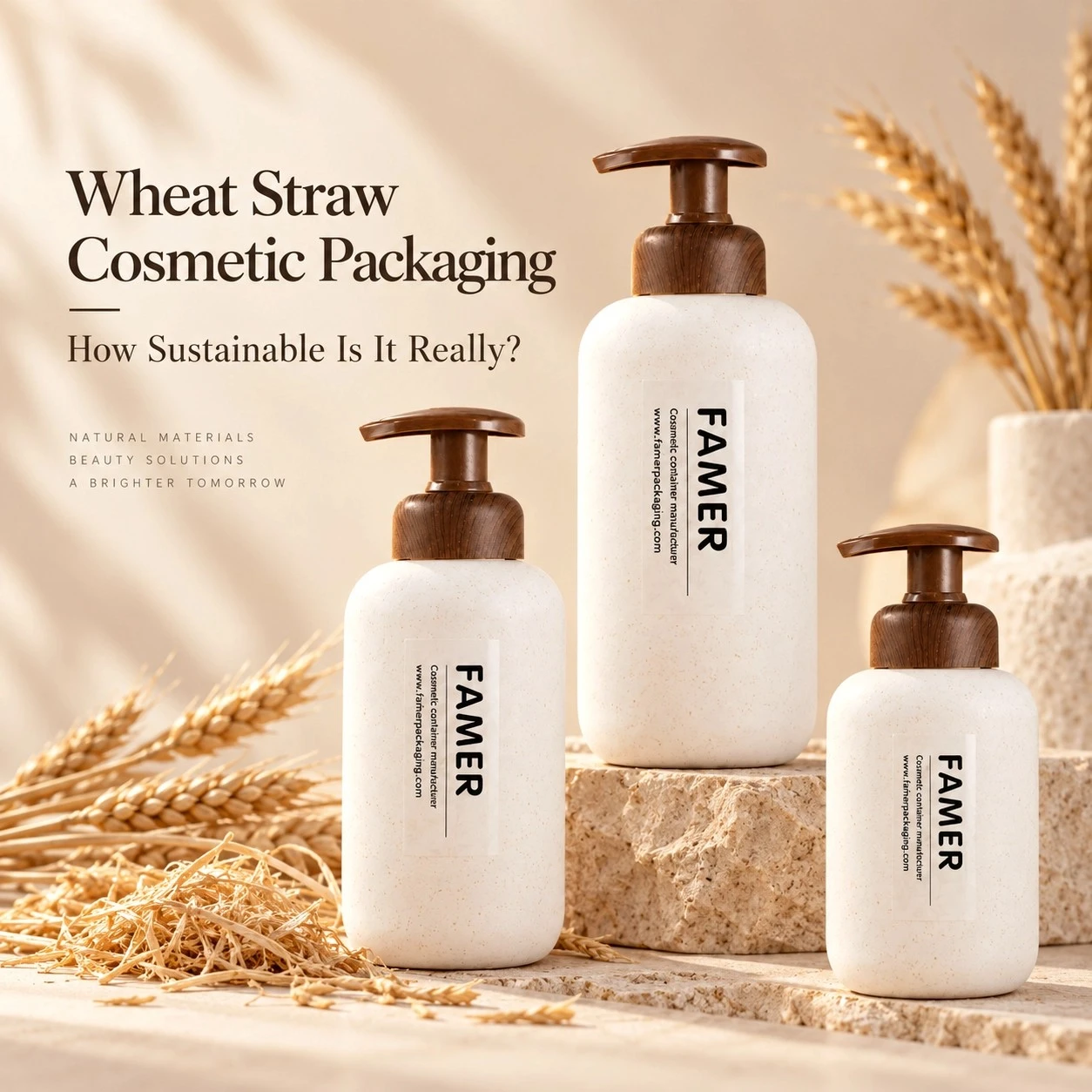
Wheat straw cosmetic packaging can reduce the amount of virgin plastic used in a package, but the plant fiber alone does not tell you whether the finished bottle, jar, or tube is biodegradable, compostable, recyclable, or lower in carbon emissions.
The answer depends on the complete material formulation.
Most wheat straw cosmetic packaging is made by combining processed wheat straw fiber with a polymer that provides the strength, moldability, and product protection required for commercial packaging. The fiber content, base resin, package design, and available end-of-life system all affect the environmental outcome.
For a cosmetic brand, this makes wheat straw worth evaluating, but it should be evaluated as a packaging material rather than as an "eco-friendly" label.
Quick answer: Wheat straw packaging can be a useful option when it replaces part of the virgin resin and still meets the product's performance requirements. Its environmental benefits should be described according to the actual material composition and supporting evidence.
What is wheat straw cosmetic packaging made from?
Wheat straw is the stalk that remains after wheat grain is harvested. For packaging use, the straw can be cleaned, processed, and incorporated into a polymer compound.
The polymer still has an important job. It gives a cosmetic bottle or tube the structural properties needed for molding, filling, transport, dispensing, and normal use.
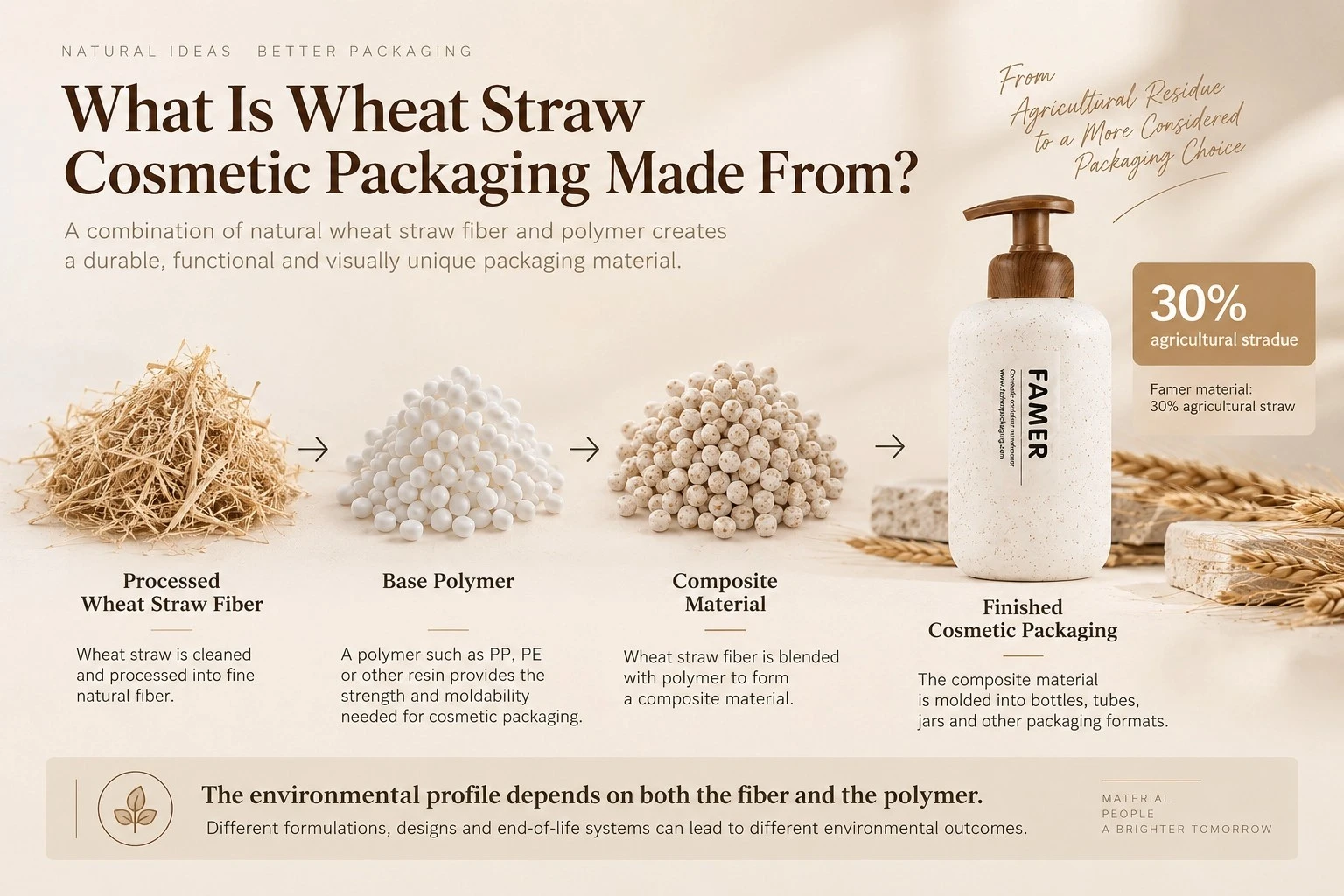
This is why two packages described as "wheat straw packaging" may have very different environmental properties. A composite based on PP or PE will behave differently from one using PLA or another polymer system.
If you are still deciding between resin types, we compared PET, HDPE, and PP bottles for cosmetics in a separate article, covering performance, compatibility, and use cases.
The percentage of wheat straw also matters.
Famer currently lists its wheat-straw fiber-based plastic as containing 30% agricultural straw. The same material page identifies it as a matte material intended for applications such as skincare packaging.
That 30% figure is useful because it describes something measurable. It should not be interpreted as meaning that every wheat straw product on the market has the same composition, or that a 30% fiber content produces a 30% reduction in carbon footprint.
When comparing suppliers, ask for two pieces of information:
- the percentage of wheat straw or agricultural fiber in the material;
- the identity of the remaining polymer.
Those answers are more useful than a generic "green material" description.
Bio-based, biodegradable, compostable, and recyclable are different claims
This is where much of the confusion around wheat straw packaging begins.
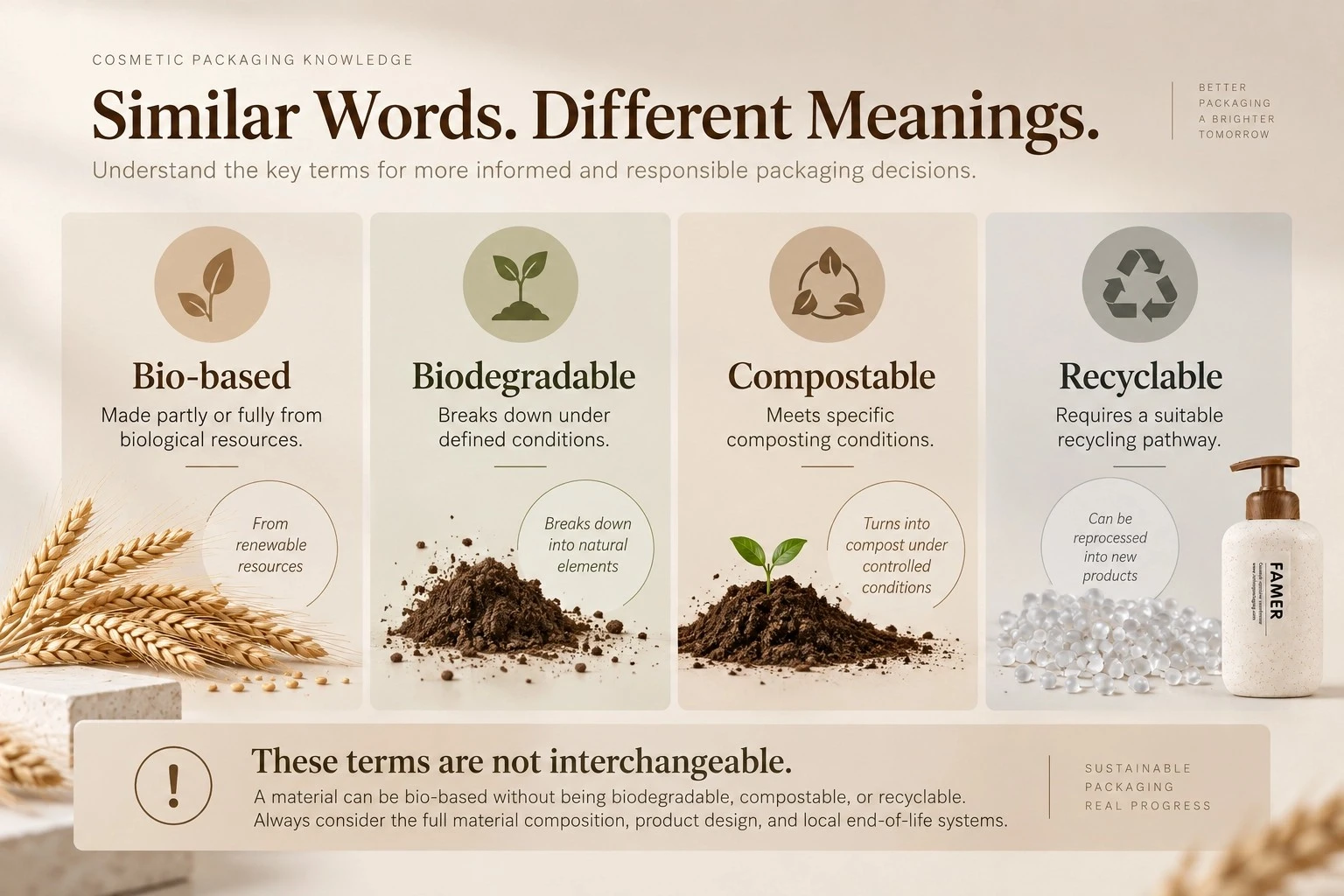
The European Commission notes that bio-based plastics may be partly or fully made from biological resources while still being neither biodegradable nor compostable.² It also recommends considering the full life cycle of these materials rather than assuming that biological feedstock alone guarantees a better environmental result.
|
Term |
What it tells you |
What it does not prove |
|
Bio-based |
Some or all feedstock comes from biological resources |
That the package will biodegrade, compost, or be recycled |
|
Biodegradable |
A material can biodegrade under defined conditions |
That it will quickly break down after normal disposal |
|
Compostable |
A material meets requirements for decomposition under specified composting conditions |
That it can be composted at home |
|
Recyclable |
A suitable recycling route exists for the material |
That every local recycling program will accept it |
This distinction is especially relevant for wheat straw composites. The plant fiber and the polymer may have very different end-of-life behavior.
The U.S. Federal Trade Commission also cautions against broad, unqualified claims such as "green" or "eco-friendly" because consumers may interpret them as implying a wide range of environmental benefits that are difficult to substantiate.¹
For packaging buyers, a specific statement such as "contains 30% agricultural straw" is much easier to evaluate than "100% eco-friendly."
Where wheat straw can improve packaging sustainability
The most direct benefit is material substitution.
When agricultural fiber replaces part of the virgin resin used in a package, that package requires less virgin polymer than an equivalent formulation made entirely from virgin resin. The size of the reduction depends on the actual fiber loading.
Wheat straw also gives an agricultural residue another material use after grain harvesting.
Neither point should be stretched into a carbon claim without supporting data. Carbon footprint depends on more than the feedstock. Processing energy, resin production, package weight, manufacturing losses, transport, and end-of-life treatment can all affect the result.
Wheat straw also creates a distinctive appearance. Visible fiber specks and a matte surface can suit botanical skincare, haircare, body care, and brands that want the packaging material itself to be visible.
That is a design advantage rather than proof of environmental performance. A package can look natural without being biodegradable, just as an environmentally preferable material does not need to look "natural."
Is wheat straw packaging biodegradable?
The answer depends on what the wheat straw is combined with.
Wheat straw fiber can biodegrade under suitable conditions. If that fiber is embedded in a conventional PP or PE matrix, however, the biodegradability of the fiber does not establish that the complete package will biodegrade.
This matters when writing product claims.
A supplier therefore needs to distinguish between:
- biodegradability of the wheat straw component;
- biodegradability of the finished composite package.
Claims such as "degrades in six months" are difficult to evaluate without knowing the material tested, the environmental conditions, and whether the result applies to the complete package.
For a cosmetic packaging project, ask for the formulation and the evidence behind the specific claim rather than relying on the material name.
What about compostability?
Compostability is more specific.
A package does not meet that description simply because one ingredient is wheat straw.
The relevant question is whether the finished material or package has been tested for the compostability claim being made.
Home composting also should not be confused with industrial composting. They operate under different conditions, and access to industrial composting facilities varies by market.
If compostability is important to your brand strategy, request the test standard, test scope, and material identification before using the claim on packaging or marketing materials.
If you are also evaluating PLA as a compostable route, we wrote Is PLA plastic good for cosmetic packaging?, covering benefits, limitations and best uses.
Can wheat straw packaging be recycled?
Recyclability is less straightforward because the answer depends on both the material and the recycling infrastructure.
A wheat straw composite may use a polymer that is commonly recycled, but the addition of plant fiber can affect how the material fits within a particular recycling stream. Pumps, caps, labels, and other components may introduce further complexity.
There is also a difference between a material being technically processable and being accepted by collection systems where the product is actually sold.
For brands selling in several markets, check local collection requirements before giving customers disposal instructions.
The supplier should be able to tell you the base polymer. The recycling program in the target market determines what happens next.
How does wheat straw compare with PCR, PLA, and sugarcane PE?
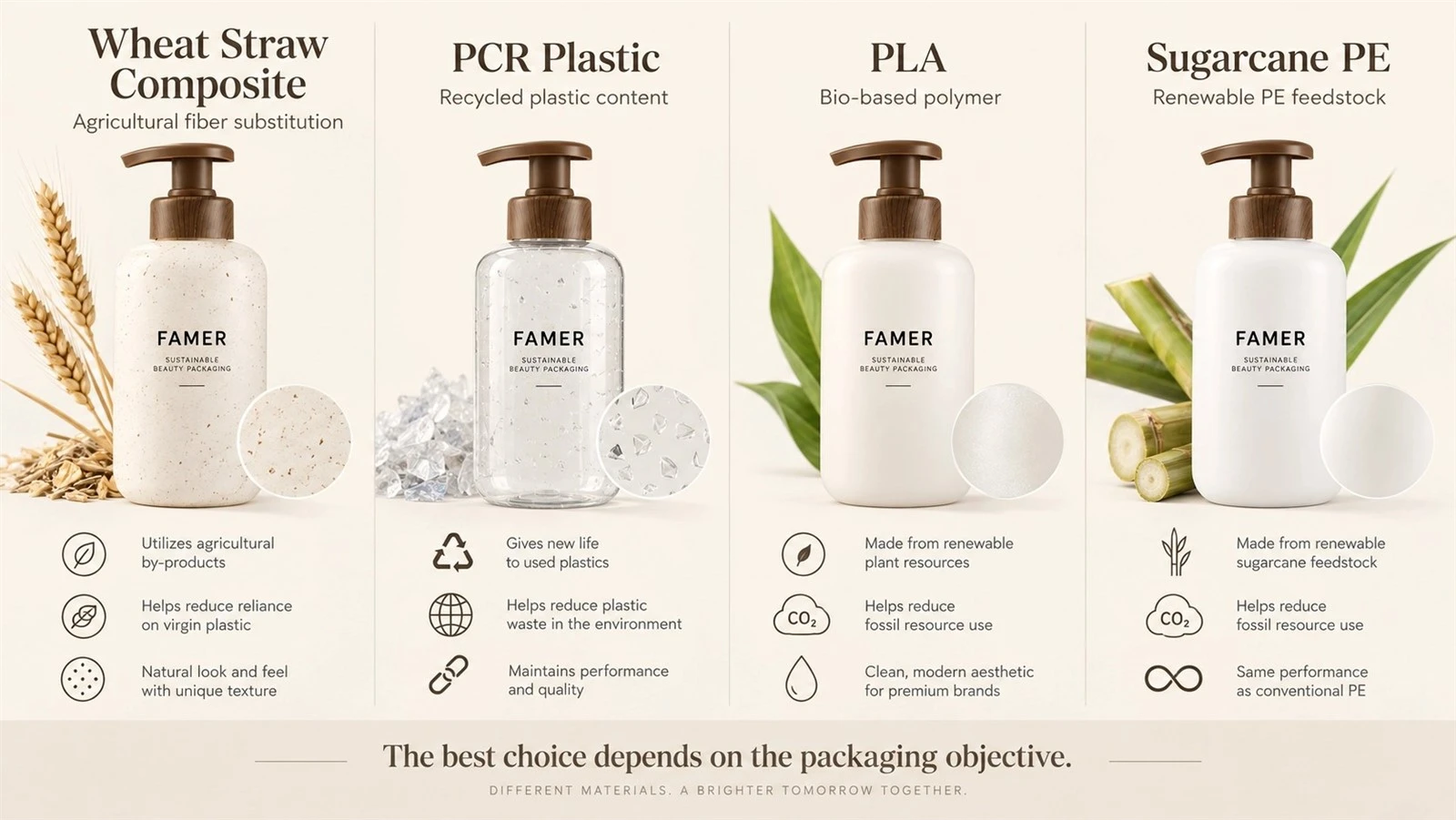
Wheat straw is one route to reducing reliance on conventional virgin plastic. PCR, PLA, and sugarcane-based PE address the problem differently.
|
Material |
Main reason brands consider it |
Important limitation or question |
|
Replaces part of the resin with agricultural fiber |
End-of-life depends on the base polymer and composite formulation |
|
|
Uses plastic that has already passed through a consumer waste stream |
Color, supply, and consistency can vary by grade and source |
|
|
Uses bio-based feedstock and can have compostable applications |
Industrial composting conditions and certification may be required |
|
|
Replaces fossil feedstock with renewable sugarcane feedstock |
It is still PE and should be evaluated accordingly at end of life |
|
|
Virgin PP/PE |
Established performance and manufacturing consistency |
Relies on virgin feedstock unless recycled or renewable content is introduced |
The better choice depends on the objective.
A brand focused on recycled content may prioritize PCR. A company trying to move toward renewable feedstock may investigate sugarcane PE. Wheat straw can make sense when replacing part of the conventional resin with agricultural fiber is compatible with the package design and the brand accepts the material's visual characteristics.
If renewable feedstock is the route you want to explore, we looked at how sugarcane-based PE compares with conventional PE for cosmetic packaging.
A single material does not need to win every category to be useful.
Will wheat straw packaging work for cosmetic formulas?
Environmental performance is only part of the packaging decision. The package still needs to protect and dispense the product throughout its intended shelf life.
Formula compatibility should therefore be checked with the actual container.
Oils, surfactants, alcohol, fragrances, active ingredients, and other formulation components can create different packaging requirements. Barrier needs also vary between products. A shampoo, for example, may not require the same package structure as an active skincare formula.
The complete package matters as well. Closure fit, pump performance, leakage, sealing, and decoration all need to work together.
This is one area where physical samples are more useful than material descriptions.
For example, Famer's current 500 ml wheat straw pump bottle is listed for shampoo, conditioner, lotion, and body wash applications. The product page offers custom colors, pump options, silk-screen printing, hot stamping, labeling, OEM/ODM development, and samples before bulk production. Its listed MOQ is 5,000 pieces.
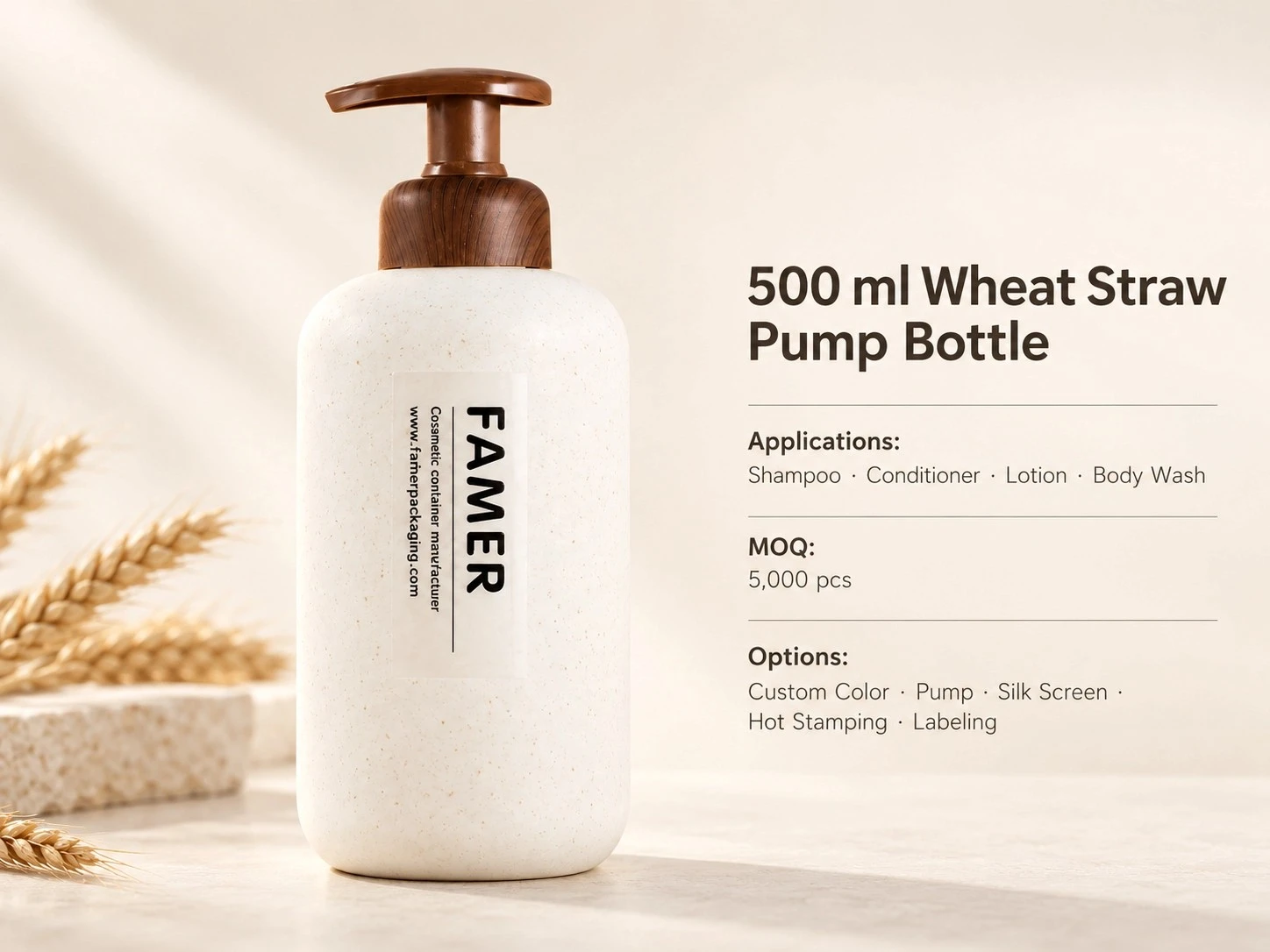
Those specifications apply to that product rather than to every wheat straw package.
The practical lesson is broader: test the proposed format, closure, decoration, and formula together before mass production.
Practical limitations to consider
Wheat straw composites have a visual character that some brands want and others may find difficult to control.
Fiber specks can create natural variation between surfaces. Color matching may therefore require physical approval when a brand has tight color standards.
The material is also better suited to opaque or naturally textured packaging than to projects that require crystal-clear transparency.
Decoration should be tested on the actual material rather than approved only from artwork. Silk screening, hot stamping, labeling, and color development may behave differently depending on the formulation and surface texture.
We covered how each printing and decoration process behaves across materials in our cosmetic packaging printing and decoration guide.
End-of-life communication can also be more complicated than it is for a simple mono-material package because the buyer needs to account for the fiber, polymer, closure, and local waste system.
These are project constraints rather than automatic reasons to reject the material. They indicate where sampling and specifications deserve more attention.
What should a buyer verify before ordering?
A short supplier check can prevent most of the common misunderstandings around wheat straw packaging.
|
Ask the supplier |
Why it matters |
|
What percentage of the material is wheat straw fiber? |
Shows how much agricultural fiber is actually being used |
|
What is the base polymer? |
Affects performance and end-of-life options |
|
What does any biodegradable or compostable claim apply to? |
Separates fiber behavior from the finished package |
|
What test report supports the claim? |
Helps verify environmental marketing language |
|
What formula testing is recommended? |
Reduces compatibility and shelf-life risk |
|
Which printing and decoration processes have been tested? |
Helps avoid unexpected surface or color results |
|
Can production samples be evaluated first? |
Allows the brand to check appearance, fit, dispensing, and formula compatibility |
|
What are the MOQ and customization limits? |
Determines whether the format suits the commercial project |
The answers should be specific to the material or SKU being quoted.
Generic statements such as "biodegradable material" or "recyclable packaging" are less useful than a composition sheet, test reference, physical sample, and clear explanation of the intended disposal route.
So, is wheat straw cosmetic packaging really sustainable?
Wheat straw cosmetic packaging can be a reasonable material choice when it replaces part of the virgin resin, performs reliably throughout the product's life, and is marketed with claims that match the evidence.
Its sustainability should not be judged from the presence of plant fiber alone.
For most buyers, four questions are enough to frame the decision:
- What is the complete material composition?
- How much virgin resin is being replaced?
- Will the package protect and dispense the cosmetic product properly?
- What realistic end-of-life route exists in the target market?
If those answers fit the project's priorities, wheat straw can be worth testing alongside PCR, PLA, sugarcane PE, and conventional packaging materials.
For an actual packaging project, the most useful next step is to review a material specification and physical sample with the final formula and decoration requirements in mind.
Frequently asked questions
Does wheat straw cosmetic packaging still contain plastic?
In most commercial composite formats, yes. Wheat straw fiber is combined with a polymer that provides structural and processing properties. Ask for both the fiber percentage and the base polymer when evaluating a product.
Is wheat straw packaging biodegradable?
The fiber may biodegrade under suitable conditions, but the behavior of the complete package depends on the polymer and formulation. Finished-package claims should be supported by appropriate testing.
Is wheat straw packaging compostable?
Only use a compostable claim when it applies to the finished material or package under defined conditions. Industrial compostability and home compostability are separate considerations.
Is wheat straw packaging recyclable?
It may be recyclable in some systems, but acceptance depends on the composite formulation and local recycling infrastructure. The supplier can identify the base material; the target market determines collection availability.
Is wheat straw better than PCR plastic?
They solve different problems. Wheat straw replaces part of the resin with agricultural fiber, while PCR uses plastic recovered from an existing waste stream. Material choice should follow the project's sustainability goal, appearance, performance, and supply requirements.
Recycled content brings its own set of details - we covered what PCR plastic is and how it behaves in cosmetic packaging in a separate article.
Can wheat straw cosmetic packaging be customized?
Yes, customization is possible for suitable product formats. For example, Famer's current 500 ml wheat straw pump bottle supports custom colors, pumps, silk-screen printing, hot stamping, labeling, and OEM/ODM development. Samples are also listed as available before bulk production.
References
1. U.S. Federal Trade Commission, Environmental Claims: Summary of the Green Guides.
Guidance on environmental marketing claims including degradable, compostable, recyclable, renewable-material, and broad environmental-benefit claims.
2. European Commission, Biobased, Biodegradable and Compostable Plastics.
Explains the distinction between bio-based, biodegradable, and compostable plastics and the need to consider life-cycle impacts.
3. ASTM International, ASTM D6400-26.
Defines requirements for labeling plastics and plastic-containing products intended for aerobic municipal or industrial composting facilities.
4. International Organization for Standardization, ISO 14040:2006.
Sets out the principles and framework used for life-cycle assessment.