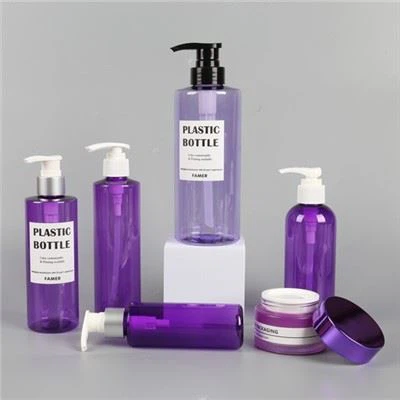

The key points of the use of standard shampoo bottle size PET materials in the injection stretch blowing process
1. shampoo bottle material- the choice of material model.
In addition to the application of PET in blowing, it is also used in the textile drawing, sheet, and injection molding industries. Due to the different requirements on the characteristics of materials, ordinary blowing grade PET generally chooses the grades with an intrinsic viscosity of 0.70-0.85dl/g. Choose a low intrinsic viscosity for forming large-capacity bottles, and select a high intrinsic viscosity for small-capacity bottles.
2. plastic container bottles-design of product stretch ratio and wall thickness.
Reasonable product draw ratio and wall thickness design help to improve the product's wall thickness distribution, barrier properties, and impact resistance. As mentioned above, the suitable PET preform stretch ratio is 1.5-2.5, and the wall thickness is 2.3-4.5mm. The wall thickness of the finished bottle should preferably not exceed 1mm.
3. The dryness of the material.
PET chips are very easy to absorb moisture in the air, and the saturated moisture content can reach 0.6%. Since PET is an ester material, if the water is not removed before molding, PET will hydrolyze at a high temperature, reducing the viscosity of the material, which will seriously affect the molding of the PET material, transparency, strength, and impact resistance of the product. Influence. Therefore, PET must be fully dried to remove the water before molding. The recommended drying conditions are 150-165°C, and the drying time should be no less than 4 hours. Too low drying temperature and too short a time cannot achieve the effect of removing moisture. Too high temperature and too long time will easily cause the material to agglomerate, which will affect the blanking. At the same time, it will cause the yellowing of the material and the production of excessive acetaldehyde, which will affect the taste of the contents, especially for water bottles. . The moisture content of the final dried material is preferably less than 40 ppm.
4. The molding process of the material-shampoo bottle recycling
PET is a crystalline material with a maximum crystallization rate of 55%. Crystallization will cause poor impact performance and reduced transparency of the bottle. The melting point of PET is 240°C, and the temperature of the injection preform is usually 260°C-300°C. It is necessary to quickly reduce the preform to 95°C-105°C, which is the best stretch orientation temperature for stretch blow molding, in order to minimize the finished product. of crystallinity. The product obtained by slow cooling is an opaque product.